

Why is Shirdi important?
Shirdi is one of India’s most visited pilgrimage towns. Devotees of every faith come to the Shri Saibaba Sansthan temple complex for darshan at the Samadhi Mandir, where Sai Baba’s mortal remains rest, and to visit the places associated with his life. Sai Baba’s teachings of faith, patience, compassion and unity continue to draw pilgrims from across India and the world.
Who was Sai Baba of Shirdi?
Sai Baba was a saint who arrived in Shirdi as a young man in the mid-1800s and lived there for the rest of his life. His origins are not known with certainty. He was first seen sitting beneath a neem tree — the place now called Gurusthan — and later made the old mosque, Dwarkamai, his home. Revered by both Hindus and Muslims, he took Mahasamadhi in Shirdi on 15 October 1918, on the day of Vijayadashami.
Among his earliest devotees was Bayajabai Kote, who fed him daily when he wandered the woods around Shirdi. Read her story.
Which sacred sites should I visit in Shirdi?
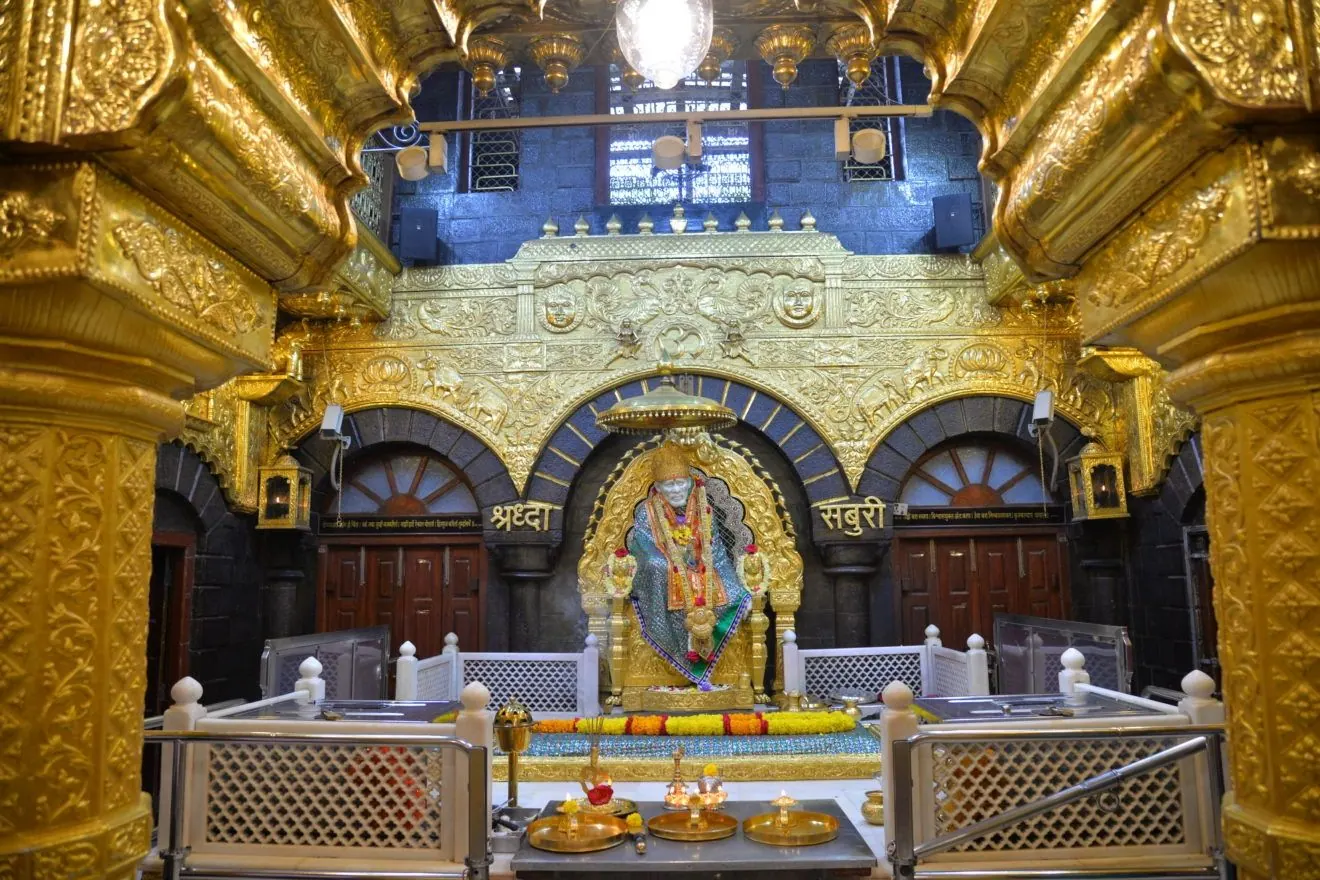
- Samadhi Mandir — The main shrine of the Shri Saibaba Sansthan temple complex, housing Sai Baba's Samadhi, where devotees attend darshan and the daily aartis.
- Dwarkamai — The old mosque where Sai Baba lived for much of his life in Shirdi. The dhuni (sacred fire) he kept is maintained here.
- Chavadi — Where Sai Baba slept on alternate nights in his later years. The Thursday palkhi procession passes here.
- Gurusthan — The neem tree where Sai Baba was first seen as a young ascetic when he arrived in Shirdi.
- Lendi Baug — A garden Sai Baba walked to and tended regularly, now maintained as part of the Sansthan's sacred sites.
- Khandoba Mandir — The temple where, by tradition, the priest Mhalsapati welcomed the young fakir with the words "Ya Sai" — giving him the name Sai.
The Shri Saibaba Sansthan complex also includes meditation spaces and the Sansthan’s Prasadalaya (dining hall) for devotees.
What are the aarti timings at the Shirdi Sai Baba temple?
The Samadhi Mandir follows a daily cycle of four aartis.
A day of aartis in Shirdi
Daily aarti schedule
- Kakad Aarti~4:30 AM
- Madhyan Aarti~12:00 noon
- Dhoop AartiAt sunset
- Shej Aarti~10:00–10:30 PM
Approximate times; Dhoop Aarti follows sunset and timings change with the season and on festival days. Please confirm with the Shri Saibaba Sansthan Trust.
Approximate times:
| Aarti | Approximate time |
|---|---|
| Kakad Aarti | Early morning, around 4:30 AM |
| Madhyan Aarti | Midday, around 12:00 noon |
| Dhoop Aarti | At sunset (time varies through the year) |
| Shej Aarti | Late night, around 10:00–10:30 PM |
Timings change with the season and on festival days. Always check the current schedule with the Shri Saibaba Sansthan Trust before you plan.
What festivals are celebrated in Shirdi?
Shirdi’s three major festivals are Ram Navami (March–April), Guru Purnima (usually June–July) and Vijayadashami (September–October), when Sai Baba’s Punyatithi is observed. These draw very large crowds, so book your stay well in advance.
Every Thursday, a palkhi (palanquin) procession moves between the Samadhi Mandir, Dwarkamai and Chavadi, accompanied by devotional singing.
How do I reach Shirdi?
- By air: Shirdi Airport has domestic flights to several Indian cities.
- By train: Sainagar Shirdi is the town’s railway station, with direct trains from several cities.
- By road: Regular state and private buses and taxis connect Shirdi with Mumbai, Pune, Nashik and other cities.
See our location page for directions to Sai Shree Hotel.
Tips for a peaceful visit
- Book darshan and aarti passes through the official Shri Saibaba Sansthan channels only.
- Thursdays, weekends, public holidays and festival days are the busiest — allow extra time.
- Dress modestly and be ready to leave footwear and large bags outside the temple.
- Keep phones and valuables secure; follow Sansthan security instructions.
- Arrange your accommodation early for festivals — enquire about rooms at Sai Shree Hotel.